Where Mountains Meet the Sky
BACHALPSEE · GRINDELWALD · SWITZERLAND
Some landscapes are beautiful. Others are iconic. And then there are places like Bachalpsee, where the boundary between earth and sky seems to disappear entirely.
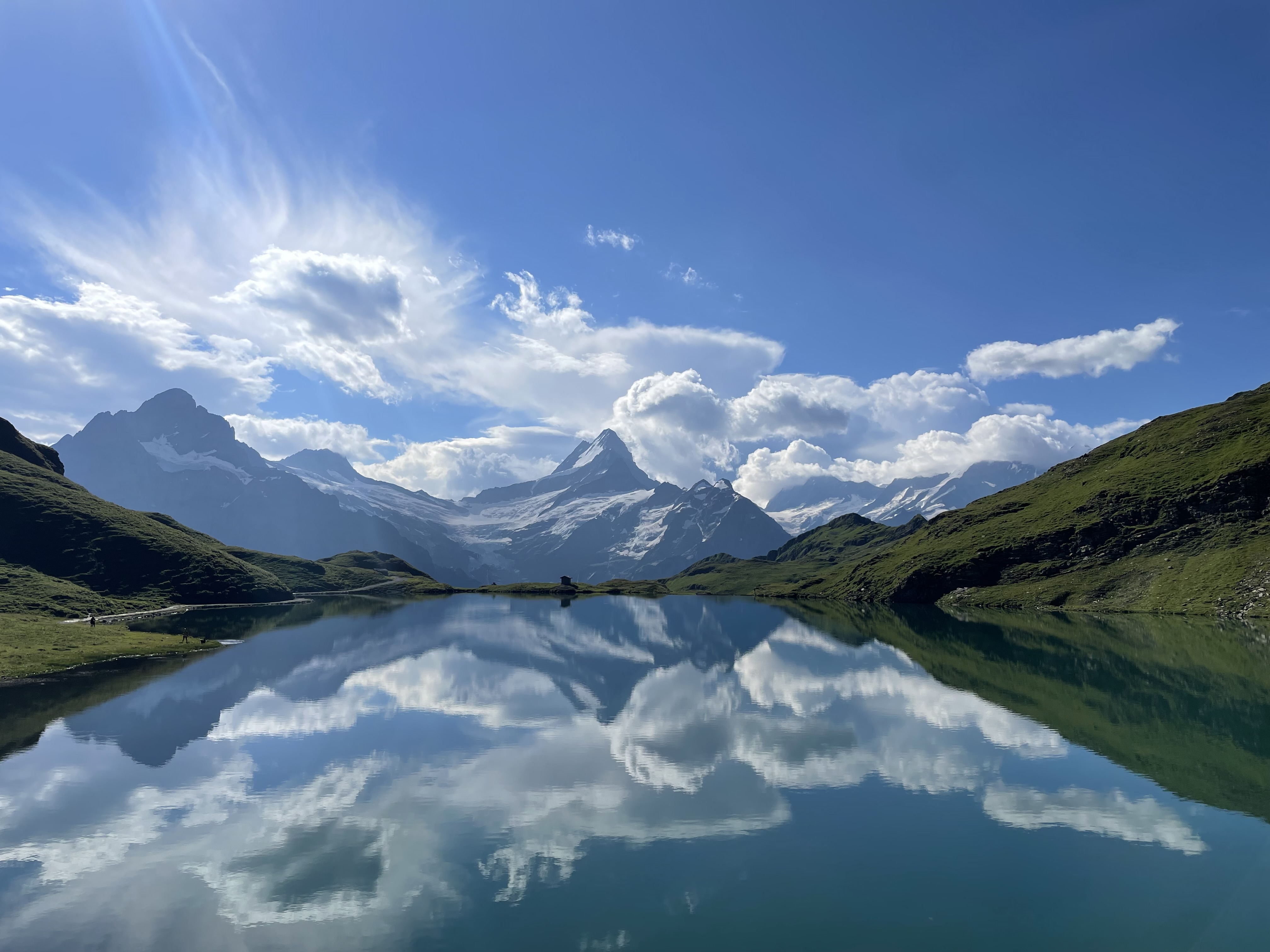
High above the village of Grindelwald, in the heart of the Bernese Oberland, a small alpine lake reflects some of the most legendary peaks in the Swiss Alps. On calm summer mornings, the water becomes a mirror, capturing the towering silhouettes of the Wetterhorn, Schreckhorn and Finsteraarhorn as if they were suspended between two worlds.
For many visitors, Bachalpsee is simply one of the most beautiful viewpoints in Switzerland. For mountaineers, geologists and photographers, however, it represents something much greater: a gateway into one of the most extraordinary mountain landscapes in Europe.
A Lake Above the Clouds
Located above Grindelwald in the Jungfrau Region, Bachalpsee sits at an altitude of more than 2,200 metres. Reaching the lake requires a journey into the high Alps, first by gondola and then on foot across alpine meadows shaped by centuries of glaciation. Despite its growing popularity, Bachalpsee retains a remarkable sense of isolation. The scale of the surrounding landscape overwhelms everything. Human presence feels temporary. The mountains dominate the horizon, just as they have for countless generations.
The lake itself owes its existence to the same forces that created the Alps. Thousands of years ago, retreating glaciers carved depressions into the landscape. As the ice disappeared, meltwater collected within these basins, forming the alpine lakes that today attract hikers and photographers from around the world.
The Kingdom of Ice and Stone
The view from Bachalpsee is dominated by a collection of mountains that rank among the most impressive peaks in Switzerland.
To the east rises the Wetterhorn, a mountain that towers above Grindelwald and has long served as one of the most recognizable landmarks of the Bernese Alps. Its steep faces, ridges and glaciers made it a symbol of early alpine exploration during the nineteenth century. The summit was first climbed in 1844 and quickly gained fame among European mountaineers.
Beyond the Wetterhorn stands the Schreckhorn, whose name can be translated as "Peak of Terror." At 4,078 metres, it is Switzerland's northernmost four-thousand-metre summit and one of the most challenging mountains in the Bernese Alps. Unlike many famous alpine peaks, the Schreckhorn remains a serious objective requiring strong climbing skills, technical ability and favourable conditions.
Further south rises the giant of the region: the Finsteraarhorn. At 4,274 metres, it is the highest mountain of the Bernese Alps and one of the most dominant peaks in Switzerland. Unlike the heavily visited Jungfrau and Eiger, the Finsteraarhorn remains isolated within a vast expanse of glaciers, giving it an almost mythical character among climbers. Its first successful ascent took place in 1829, during a period when much of the high Alps remained unexplored.
Together, these mountains create the dramatic skyline that has made Bachalpsee famous throughout the world.
The Golden Age of Alpinism
The mountains surrounding Grindelwald played a crucial role in the development of modern mountaineering.
During the nineteenth century, explorers, scientists and adventurers from across Europe travelled to Switzerland in search of unclimbed summits. What followed became known as the Golden Age of Alpinism.
The Wetterhorn became one of the defining peaks of this era. Reports of early ascents helped inspire a generation of British climbers who would later attempt many of the Alps' greatest challenges. The mountain's reputation spread far beyond Switzerland, transforming the Bernese Oberland into one of the birthplaces of mountaineering tourism.
The Schreckhorn and Finsteraarhorn offered even greater challenges. Their steep ridges, exposed rock and glaciated approaches demanded not only courage but technical skill. These were not simply mountains to be admired from below; they became proving grounds for the pioneers of alpine climbing.
Many of the routes established during that period remain among the most respected alpine climbs in Europe today.
The Rock Beneath the Peaks
The beauty of the Bernese Alps is not only visible in their shape but also in their geology.
The mountains visible from Bachalpsee are part of a landscape forged during the Alpine orogeny, the immense geological process that created the Alps through the collision of tectonic plates. Millions of years of uplift, compression, erosion and glaciation transformed ancient rock into the dramatic peaks that dominate the skyline today.
Many of the highest summits are composed of crystalline rocks such as granite, gneiss and amphibolite. These rocks are among the oldest geological foundations of the region, shaped under enormous pressure deep within the Earth's crust before eventually being pushed skyward.
The result is a landscape that appears timeless but remains constantly changing. Frost, avalanches, glacial movement and weather continue to sculpt the mountains every year.
The Shadow of the Glacier
Visible from this viewpoint is the legacy of Grindelwald's glaciers.
For centuries, rivers of ice flowed through the valleys below, shaping the terrain and defining the character of the region. The Grindelwald glaciers became some of the most studied glaciers in Europe and played an important role in the early understanding of glacier science.
Today, however, the glaciers are changing rapidly. Like many glacial systems across the Alps, they have retreated significantly since the end of the Little Ice Age and continue to shrink as temperatures rise. Researchers consider the region one of the most important natural laboratories for observing the effects of climate change in high mountain environments.
"Standing beside Bachalpsee, it is easy to admire the beauty of the Alps. It is far harder to comprehend the scale of time that created them."
A Photographer's Perspective
This image was captured during a period of calm weather when the surface of Bachalpsee transformed into a near-perfect mirror.
Moments like these are surprisingly rare. A slight breeze is enough to break the reflection. A passing cloud can alter the entire mood of the landscape. Timing becomes as important as composition.
What fascinated me most was not a single mountain or feature, but the relationship between them. The lake, the glaciers, the peaks and the sky combine to create a scene that feels almost unreal, as if the landscape were folding back on itself.
It is one of those places where photography becomes something more than documentation. It becomes an attempt to preserve a feeling.
Where Mountains Meet the Sky
The title of this story comes from the illusion that defines Bachalpsee.
When the lake is calm, reflections erase the distinction between above and below.
Mountains float. Clouds sink into the water. The horizon disappears.
For a brief moment, the landscape feels suspended between reality and reflection.
Perhaps that is why Bachalpsee has become one of the most beloved alpine locations in Switzerland. It is not simply a viewpoint. It is a place where geology, history, exploration and natural beauty converge into a single unforgettable scene.
A place where mountains truly seem to meet the sky.
Photo Notes
Location: Bachalpsee, Grindelwald, Switzerland
Region: Bernese Oberland
Visible Peaks: Wetterhorn, Schreckhorn and Finsteraarhorn
Nearby Giants: Eiger, Mönch and Jungfrau
Category: Landscape Photography
Photographer: Carles Torres